Virtual agent software is reshaping how organizations handle customer service, IT support, HR queries, and everyday business operations. As contact center AI transforming customer support becomes more mainstream, businesses are leveraging intelligent automation to deliver faster, more consistent interactions. Instead of waiting in phone queues or inbox backlogs, customers and employees can get instant, accurate answers from conversational agents that never sleep—driving powerful AI customer service optimization across channels.
In today’s rapidly evolving business landscape, the combination of cloud-based AI platforms for enterprise automation and modern computer technology infrastructure for intelligent operations allows companies to deploy virtual agents more efficiently, ensuring seamless integration with existing systems and databases. Beyond support, businesses are embracing AI-powered digital marketing platforms for personalized customer engagement and automated marketing analytics using artificial intelligence to better understand audience behavior, predict trends, and optimize campaigns in real time.
The financial sector is also experiencing significant transformation with AI-driven financial process automation and intelligent risk management solutions, helping banks, fintechs, and investment firms improve transaction efficiency, detect irregularities, and provide smart advisory services. By connecting these innovations across IT systems, marketing channels, and financial operations, organizations create a cohesive, AI-enhanced ecosystem that supports both customer-facing and internal workflows, demonstrating how virtual agent software fits into broader technology-driven business optimization strategies.
This guide walks through what virtual agents are, how they work, the key benefits, real-world use cases, and what to look for when choosing a solution. If you are exploring automation to scale your support operations without sacrificing experience, this is your roadmap.
Top 10 AI Virtual Agent Software and Contact Center Solutions
Choosing the right AI virtual agent software can transform your customer support, streamline operations, and improve overall efficiency in call centers and contact centers. Here’s a list of the leading platforms that businesses are using to modernize their support operations, with a focus on AI-powered automation, intelligent routing, and omnichannel capabilities.
1. Bright Pattern – AI Contact Center Solutions
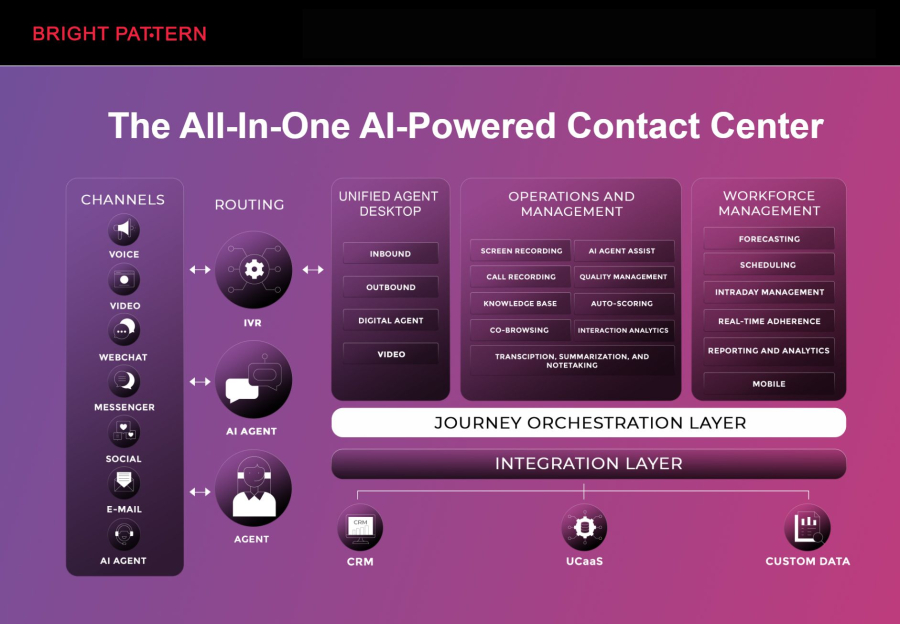
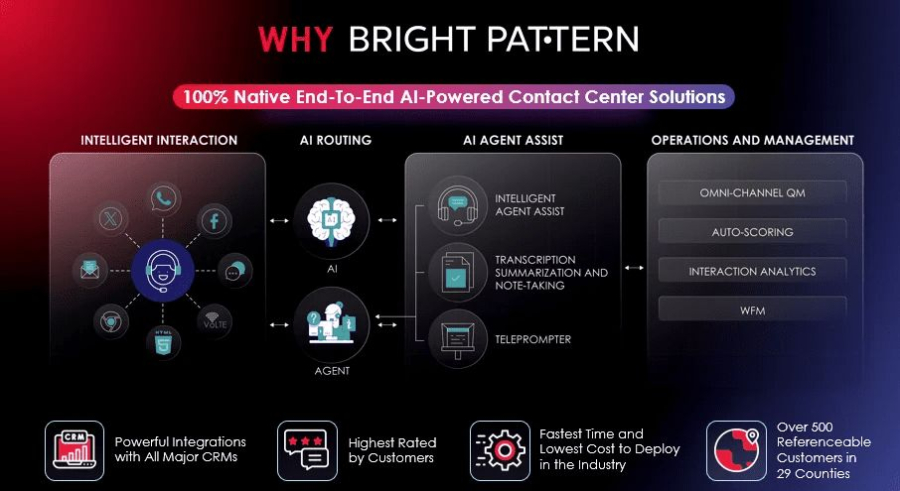
Bright Pattern is a leading provider of AI virtual agent software and cloud contact center solutions, trusted by businesses worldwide to deliver smarter, faster, and more personalized customer interactions. Its platform combines advanced AI with omnichannel capabilities, enabling seamless communication across voice, chat, email, SMS, and social media.
Key Features:
- AI-powered virtual agents for automated self-service and support
- Intelligent call routing and agent assistance tools
- Omnichannel contact center capabilities for a consistent customer experience
- Integration with CRM systems and business applications
- Real-time analytics and reporting for performance optimization
- Scalable cloud-based infrastructure for global operations
Bright Pattern helps organizations reduce response times, improve first-call resolution, and deliver personalized interactions while maintaining flexibility for future growth in AI-driven contact centers.
2. Genesys Cloud CX
Genesys Cloud CX offers a comprehensive AI-driven contact center platform with intelligent routing, virtual assistants, and predictive analytics for enhanced customer experiences across multiple channels.
3. Five9 Intelligent Cloud Contact Center
Five9 provides AI-enhanced virtual agent software for call centers, combining predictive dialing, natural language understanding, and real-time agent assistance to boost productivity.
4. Talkdesk CX Cloud
Talkdesk offers a cloud-based contact center solution with AI virtual assistants, advanced workflow automation, and omnichannel support, helping businesses streamline customer engagement.
5. NICE CXone
NICE CXone integrates AI-powered virtual agents with analytics, workforce optimization, and cloud contact center tools to improve service efficiency and agent performance.
6. Avaya OneCloud CCaaS
Avaya’s cloud contact center platform combines AI contact center capabilities, voice, messaging, and intelligent routing to enhance customer service operations.
7. 8x8 Contact Center
8x8 provides a unified platform with virtual agent support, predictive analytics, and cloud-based infrastructure to deliver intelligent customer experiences across channels.
8. RingCentral Contact Center
RingCentral offers AI-assisted call routing, virtual agents, and omnichannel engagement features that allow contact centers to operate more efficiently and respond faster to customer needs.
9. Cisco Contact Center
Cisco Contact Center solutions integrate AI-driven virtual agents, advanced reporting, and workflow automation for large enterprises looking to scale operations.
10. SAP Customer Experience (CX) Service Cloud
SAP CX Service Cloud uses AI virtual agents, machine learning, and intelligent case management to enhance support workflows and provide personalized customer service
What Is Virtual Agent Software?
Virtual agent softwareis an AI-powered application that interacts with users through natural language, typically via chat or voice. It understands questions, provides answers, completes tasks, and guides users through processes, often without human intervention.
Unlike simple chatbots that rely on rigid scripts and keyword matching, modern virtual agents use techniques such as natural language understanding (NLU), machine learning, and context management to deliver more human-like, flexible conversations.
Key Characteristics of a Virtual Agent
- Conversational interfacethat supports natural language, not just button clicks or fixed commands.
- Task completioncapabilities, such as resetting passwords, creating tickets, booking appointments, or updating records.
- Integrationwith back‑end systems (CRM, ITSM, HRIS, commerce platforms) to pull and push data.
- Context awarenessto remember what a user said earlier in the interaction and personalize replies.
- Escalation pathwaysto transfer complex issues to human agents with full conversation history.
How Virtual Agent Software Works
Behind every smooth, friendly virtual agent is a set of technologies working together to interpret questions and produce useful answers.
Core Components
- Natural Language Understanding (NLU)interprets user input, identifies intent (what the user wants), and extracts entities (such as dates, names, or order numbers).
- Dialogue managementcontrols the flow of the conversation, deciding which questions to ask next and when to provide answers or actions.
- Knowledge and content layerincludes FAQs, knowledge articles, process rules, and business logic that the agent uses to respond.
- Integrations and APIsconnect the virtual agent to systems such as CRM, ticketing, ERP, or collaboration tools to retrieve or update information.
- Analytics and training toolstrack performance, highlight gaps, and enable continuous improvement through tuning and retraining.
From Question to Answer: A Simple Flow
- User asks a question.For example, “Where is my order?” or “I can’t access my account.”
- Agent interprets intent.NLU identifies this as atrack orderoraccount accessrequest.
- Agent gathers details.It may ask for an order number, email, or verification information.
- Agent calls back‑end systems.Through APIs, it retrieves order status, resets a password, or opens a support ticket.
- Agent responds and acts.It shares the order location, completes the requested task, and offers next best steps.
Business Benefits of Virtual Agent Software
Organizations adopt virtual agents because they combine efficiency with a better user experience. When implemented well, they drive measurable results across cost, satisfaction, and operational performance.
1. 24/7 Availability Without Adding Headcount
Virtual agents work around the clock. Customers and employees can get help on weekends, holidays, and overnight without waiting for office hours. This continuous coverage is especially valuable for global businesses or teams supporting multiple time zones.
Impact:Reduced after‑hours call volume, fewer abandoned contacts, and higher satisfaction for users who expect instant answers any time of day.
2. Lower Support Costs and Higher Efficiency
Most service operations spend a large portion of their budget on handling repetitive questions: password resets, account queries, simple status checks, and basic troubleshooting. Virtual agents are ideal for automating these high‑volume, low‑complexity tasks.
- Deflect a significant share of chats, calls, and emails from human agents.
- Shorten average handle time by resolving issues faster or pre‑collecting data before a human takeover.
- Delay or avoid adding new headcount as volumes grow.
The result is a leaner support operation that can handle more inquiries without linearly increasing staffing costs.
3. Consistent, High‑Quality Answers
Human agents have varying experience levels, memory, and interpretation of policies. Virtual agents, by contrast, deliverstandardized responsesbased on centrally managed knowledge and rules.
This consistency helps you:
- Reduce errors and miscommunication.
- Enforce compliance and policy standards.
- Ensure customers receive the same guidance regardless of channel or time.
4. Happier Customers and Employees
When people can resolve issues quickly and independently, their overall experience improves. Virtual agents support this by offering self‑service that feels natural and responsive.
- For customers:Faster answers, less waiting, immediate transparency on status, and self‑service options at any hour.
- For employees:Quicker access to HR, IT, and internal help desk support, which reduces friction and boosts productivity.
5. More Engaged and Productive Human Agents
By taking care of repetitive inquiries, virtual agents free human agents to focus on more complex, higher‑value conversations.
This leads to:
- Less burnout from handling the same basic questions all day.
- More time for empathy, problem solving, and relationship building.
- Opportunities to upskill agents into advisory or specialist roles.
6. Actionable Insights From Every Conversation
Virtual agent software typically includes rich analytics on topics, intents, resolution rates, and user satisfaction. This data reveals:
- Which questions are asked most frequently.
- Where knowledge gaps exist in your support content.
- Which journeys cause friction or repeated contacts.
Armed with these insights, you can refine processes, improve web content, and continuously tune the virtual agent for better outcomes.
Common Use Cases for Virtual Agent Software
Virtual agents are versatile. While customer service is a primary use case, modern deployments extend across departments and industries.
Customer Service and Support
- Answering product and policy FAQs.
- Tracking orders, shipments, and deliveries.
- Managing returns, refunds, and exchanges.
- Helping users troubleshoot common technical issues.
- Collecting feedback or post‑interaction surveys.
IT Service Desk and Technical Support
- Resetting passwords or unlocking accounts.
- Helping users install software or configure devices.
- Automating ticket creation and status updates.
- Guiding users through basic diagnostics before human escalation.
HR and Employee Services
- Answering questions about benefits, leave, and policies.
- Helping employees find forms and internal resources.
- Guiding workers through onboarding steps.
- Supporting common requests such as address changes or payslip access.
Sales, Marketing, and E‑Commerce
- Recommending products or services based on user needs.
- Handling pre‑sales questions about pricing, features, or compatibility.
- Assisting with cart recovery by reminding users of abandoned items.
- Qualifying leads and routing them to the right sales representative.
Industry‑Specific Scenarios
- Banking and financial services:Balance inquiries, transaction history, card controls, and basic account questions.
- Telecommunications:Plan details, usage checks, and simple network troubleshooting.
- Healthcare:Appointment guidance, directions, and general information about services or processes.
- Education:Admissions FAQs, course information, and campus services guidance.
Key Features to Look For in Virtual Agent Software
Not all virtual agents are created equal. The right platform should align with your business goals, technical landscape, and user expectations.
1. Strong Natural Language Capabilities
Users phrase questions in many different ways. Effective virtual agents should handle this variability gracefully.
- Robust intent recognition with support for synonyms and varied phrasings.
- Support for multiple languages if you serve international audiences.
- Handling of typos, shorthand, and informal language.
2. Omnichannel Deployment
Consider where your users are most active. Leading virtual agent platforms support multiple channels from a single brain.
- Web chat widgets.
- Mobile apps or in‑app messaging.
- Messaging channels such as SMS or business chat tools.
- Voice interfaces integrated with telephony systems or voice assistants.
3. Deep Integrations With Your Systems
To move beyond basic Q&A, your virtual agent must connect to the systems that run your business.
- Customer relationship management (CRM).
- Ticketing and IT service management tools.
- HR and payroll platforms.
- Order management, inventory, and billing systems.
Look for an open, API‑friendly platform that can plug into both modern and legacy applications.
4. No‑Code or Low‑Code Conversation Design
Your subject matter experts and operations teams should be able to build and refine journeys without heavy developer dependence.
- Visual flow builders for conversation design.
- Reusable building blocks for common tasks.
- Versioning and testing tools to experiment safely.
5. Powerful Analytics and Reporting
Visibility drives improvement. Analytics should make it easy to see what works and where to focus optimization efforts.
- Volume by channel, topic, and intent.
- Containment and resolution rates.
- Time to answer and average conversation length.
- User satisfaction scores or sentiment indicators.
6. Seamless Human Handover
Even the best virtual agents cannot handle every situation. Smooth escalation protects the user experience and agent productivity.
- Transfer to live chat, phone, or ticket with full conversation history.
- Routing based on topic, priority, or customer segment.
- Clear messaging to the user when a human is joining the conversation.
7. Security, Privacy, and Compliance
Virtual agents often handle sensitive data. Prioritize solutions that offer robust protections.
- Data encryption in transit and at rest.
- Granular access controls and audit logging.
- Features that support compliance with relevant regulations in your region and industry.
Steps to Implement Virtual Agent Software Successfully
A successful virtual agent rollout is as much about strategy and change management as it is about technology. A structured approach ensures fast wins and long‑term value.
1. Define Clear Objectives and Use Cases
Start with business outcomes, not features. Common goals include:
- Reducing contact volume to human agents.
- Improving first‑contact resolution.
- Enhancing self‑service adoption.
- Providing consistent experiences across channels.
Choose initial use cases with high volume and relatively low complexity for quick, visible wins.
2. Map User Journeys
Identify how customers or employees currently seek help and where friction arises. Then design conversations that mirror natural paths and expectations.
- List frequent questions and reasons for contact.
- Group them into themes or intents.
- Sketch conversation flows, including clarifying questions and outcomes.
3. Prepare and Organize Your Knowledge
Virtual agents are only as strong as the knowledge they draw from. Review your existing FAQs, knowledge base articles, and internal documentation.
- Consolidate duplicate or outdated content.
- Rewrite complex answers into concise, conversational language.
- Fill gaps for common questions that lack clear guidance.
4. Integrate With Core Systems
Plan your integrations early so the virtual agent can complete meaningful tasks, not just answer static questions.
- Decide which systems the agent must connect to for phase one.
- Work with IT to design secure, reliable API connections.
- Test data flows carefully before going live.
5. Pilot, Learn, and Iterate
Launch in a controlled way, then optimize quickly based on real user behavior.
- Start with a specific audience segment or channel.
- Collect feedback and monitor analytics daily in the early weeks.
- Refine intents, flows, and responses based on what users actually ask.
6. Promote Adoption and Set Expectations
Introduce your virtual agent as a helpful, always‑available assistant. Explain what it can do well today and how it will improve over time.
- Use friendly branding and clear naming.
- Highlight tasks the agent handles best, such as quick account checks or standard requests.
- Make escalation options visible so users feel supported if the agent cannot help.
Measuring the Success of Your Virtual Agent
Tracking performance ensures that your virtual agent continues to create value and align with evolving business goals.
Core Metrics to Monitor
| Metric | What It Shows | Why It Matters |
| Containment rate | Percentage of interactions resolved without a human agent. | Indicates how effectively the virtual agent handles inquiries. |
| Resolution rate | Share of interactions where the user’s problem is fully solved. | Reflects quality of answers and task completion. |
| Average handling time | Time from first question to resolution. | Helps quantify speed improvements versus traditional channels. |
| Deflection rate | Reduction in live agent contacts for targeted topics. | Connects automation to operational cost savings. |
| User satisfaction | Ratings or sentiment after interactions. | Shows how users perceive the virtual agent experience. |
Qualitative Feedback
Beyond numbers, user comments and agent feedback provide invaluable insights.
- Ask short, optional questions at the end of conversations.
- Review transcripts where users expressed confusion or frustration.
- Gather input from support teams on where the agent can take on more tasks.
Best Practices for High‑Performing Virtual Agents
To maximize results, treat your virtual agent as a living, evolving part of your service strategy.
Design With Empathy
Write responses in clear, human language. A friendly tone and simple wording make the experience feel approachable and trustworthy.
- Avoid jargon unless you are sure your users understand it.
- Break complex instructions into small, step‑by‑step messages.
- Acknowledge user frustration and show understanding when issues are serious.
Start Focused, Then Expand
Trying to automate every possible question from day one can dilute impact. Start by solving a narrow set of high‑value problems extremely well.
- Prioritize the top 10 to 20 contact drivers.
- Ensure these flows are polished and reliable.
- Gradually add new intents based on demand and performance.
Keep Humans in the Loop
Virtual agents are most powerful when they complement, not replace, human expertise.
- Give agents tools to see conversation history and context on transfer.
- Allow agents to flag gaps where the virtual agent needs better content.
- Use agent input to train new intents and refine responses.
Continuously Train and Optimize
Language trends, products, and policies all change over time. Commit to ongoing training.
- Review unrecognized questions regularly to create new intents.
- Update knowledge as offerings or policies evolve.
- Experiment with variations of prompts to improve clarity and completion.
The Future of Virtual Agent Software
Virtual agents are rapidly advancing, driven by improvements in AI and changing user expectations.
More Natural, Context‑Rich Conversations
As underlying models improve, virtual agents are becoming better at understanding nuanced requests and maintaining context over longer interactions. This paves the way for more consultative, multi‑step conversations rather than one‑off answers.
Deeper Personalization
Future virtual agents will increasingly tailor recommendations and responses based on user history, preferences, and behavior, while respecting privacy and consent. This creates experiences that feel more like a trusted advisor than a generic help tool.
Expanded Roles Across the Organization
Virtual agents are moving beyond support into proactive engagement: nudging users to complete tasks, reminding customers about renewals, and alerting employees to important updates. In many organizations, they will become a central, intelligent layer that connects people to services across the business.
Putting It All Together
Virtual agent software is a powerful way to modernize your service experience and scale support without sacrificing quality. When thoughtfully designed and continuously improved, a virtual agent can:
- Deliver instant, 24/7 assistance to customers and employees.
- Reduce operational costs by automating routine inquiries.
- Free your human agents to focus on complex, high‑impact work.
- Provide rich insights that drive better products, content, and processes.
By choosing the right platform, starting with targeted use cases, and committing to ongoing optimization, you can turn a virtual agent into a strategic asset that supports growth, protects margins, and elevates every interaction with your brand.
